The Photo-book
The origins of the first Photo-Book can be traced back as early as 1843 and was attributed to Anna Atkins (1799- 1871) "British Algae -Cyanotype impressions"
 |
| Anna Atkins |
Atkins is considered to be the first female photographer. After; studying botanology, during a period when science for women was almost impossible. It was in 1841, that Anna met William Henry Fox Talbot Talbot who was a friend of her father’s. Anna realised the possibilities that photography could offer to her scientific research. Anna mastered the procedure of cyanotype a technique which was just discovered and practised by Herschel (1792-1871). Anna favoured this process due its stability. Many of Anna’s pictures still exist today. The book that took 10 years to complete and was published before Talbot's publication" The pencil of nature"
 |
| Anna Atkins book cover |
 |
| Henry Fox Talbot |
 |
| The Boulevards of Paris - Plate 2 |
 |
| The Pencil of Nature |
The Pencil of Nature, 1844-1846 -Printed book in six parts with 24 salted paper prints from paper negatives c. 1844-46 In the Pencil of Nature’ Talbot outlines the potential uses of photography as: Scientific proof, Legal evidence, Record , Artistic experiment. For use in public exhibitions a keepsake and a process in which to copy existing images. (Talbot, 1844-1846)
Photography and Visual literacy
In telling visual stories about the world, photography is narrating the world. Of course, narrative is something that is far larger than photography. Social communication is one of the defining characteristics of being human, and narrative stories have long been a common and powerful mode for transmitting information. (Feldman 2010)
A narrative is an account of connected events. To think about narrative, however, involves more than just reflecting on how a series of events become connected. We need to think about how events, happenings are constructed as an event in the first place. Events are not found objects waiting to be discovered. As ‘Allen Feldman’ (2010) has stated “the event is not what happens. The event is that which can be narrated”
Importance of Photography
Since the explosion of the digital age we have witnessed a change from the written language to the visual language, bombarded daily with images from all over the globe from events recorded by ‘By-Stander Intervention’ and without thought or real consideration of the impact they may have, within minutes the images are viral. Photography is still as powerful today as it has always been. In 1992, which feels only like yesterday to me, hardly anyone owned a modem and the Internet was just taking its first breath. We lived in a world where email was something for the future, and mobile phones had to be carried around in a small suitcase. Marketing in the photography business during those days depended upon such relics as the Yellow Pages and the good old land-line telephone.
Even if a photographer did have a website, hardly anyone would have known what that actually was, or how to find it. Back then, very few people imagined that having a website would one day become almost as necessary as clothing. Words like “Google“, “Facebook“, “SEO“, “Internet marketing“, and “blog” were either not yet invented, or so obscure that only a select few had any clue what they could possibly mean.
How times have changed!
Fast forward to 2012, and here we are in a world where everything runs at a million miles an hour. The world has gone from having no Internet to being unable to function without it.
The Social Media Problem
As Magnum Photographer, Martin Parr, points out, that last New Year’s Eve 750 million images were posted to Facebook in one night. ‘Incredible’. Parr questions this and asks,
‘Is it insecurity? Or as my research suggests, it can be categorised by the term ‘Altruism’. Altruism is one aspect of what social psychologists refer to as, pro-social behaviour? Pro-social behaviour refers to any action that benefits other people, no matter what the motive or how the giver benefits from the action. Neurological Reasons: Altruism activates reward centres in the brain. Neurobiologists have found that when engaged in an altruistic act, the pleasure centres of the brain become active. (Education Psychology)
It can be said from personal experience in a world of digital technology that practising professional photographers are printing less and less. This is clearly reflected in the high street photography store and indeed the professional photographic print lab that have become increasingly difficult to find and those who are trading often operate on line only. The client no longer requires a hard copy print and it has become the norm to supply work on a CD. The same can be said for photographers, “how many of us print out our work in favour of the CD”? “Very sad”.
Presentation
Although the concept of a Photo-Book is nothing new, wedding photographers: adopted this presentation medium, and is synonymous within that arena. However; I do think that this concept can be developed further. Let me explain: Over the years I have witnessed some terrible examples of Photo-book’s, especially on the portrait and wedding landscape. Although this influenced my own decision not to adopt this method of presentation, I feel I have been a little hasty. I myself would often opt for the digital presentation on meetings with new clients. However; I can remember several meetings, one with the BBC and the other with Robson Brown advertising agency and presenting my work as prints, mounted on 5mm foam board. Of course the result was, I one the day. Thinking back to this and comparing that method with a one recently, presented on a laptop the print option is far superior and adds a higher perceived value to your work. So on reflection this can present a huge opportunity to; not only present a portfolio, but to further develop a commercial relationship with the client/commissioner.
So the importance of producing a Photo-Book extends further than just considering a layout. The book becomes an ‘Object of Art’. The Photo-book should carry the same interest as did a novel in the world of literacy. However, the book has a distinct advantage over the written word alone presenting a deeper connotation in that you can touch it. Appealing to our sensory perceptions; moving from a 2 dimensional object to a 3 dimensional experience, presenting stories in a more intense way. Therefore; the Photo-Book becomes an object of
Art. If presented within a high quality photo-book and well sequenced and narrated, appealing to both the cognitive and psychomotor domain of the human senses: will far outweigh any electronic presentation, day after day.
Conclusion
As we continue through this change in visual culture, it is has become even more evident that Photography is still as powerful as ever. Thus: providing us with a unique opportunity to better understand our history. The Photo-Book enables us to further harness the visual skill set of the photographer. To tell a story with visually stunning imagery, engaging a client or commissioner in a way not often practiced. Photography provides us with a dialogue about the world; it shapes and changes every aspect of our experience of it. Engaging readers to better understand how our lives have been transformed and shaped through our interactions with photographic imagery.
The Book Design Challenge
Although a great deal of thought must be applied to the design element, I think it is of paramount importance that the book stays a photography book and nothing else. The design element is there, just not as evident as some other books. Considering the choice of paper and colour is an important factor. The main focus must be on creating a sequence and this where the design element can often be hidden. Photographers are notoriously lousy editors and experience difficulty, this is where a designer comes into his or her own.
Taking into account the above notes, I firmly believe in stepping out of ones comfort zone and attempt new challenging experiences. Let us not undervalue the photographer. For example the photographer demonstrates experience and knowledge of all three-tier design layers — the design knowledge, as well as the photographic quality knowledge, as well as the storyline knowledge — so then you are capable of using these layers with careful consideration and create a Photo-Book.
Initial thoughts
When faced with producing a Photo-Book further detailed consideration must be applied beforehand. I chose to focus on a chef. This is quite simply an area that both excites and interests me. An arena I wish to further develop and explore as my practice continues to grow. Furthermore, the chosen theme or project must reflect a book potential. Personally I have a history in Photojournalism and therefore an idea in narrative sequencing and a basic understanding of my chosen area of investigation.
The Process
Photojournalism means you need to spend time with project, and that goes for my work as well — you need to spend time. The actual designing or laying-out or editing is not so interesting to me but the reflection is interesting. That means you need something to reflect on.
The first step was take the photographs off the screen, put them on paper and put them on the table. The second step is to put the photographs in order. Go through it again. Then things start to happen, and you reflect on that.
Basically the whole process of book designing as I have learnt’ is repeating those steps one after the other. By going through it many times, you come up with ideas and then more ideas.
Design notes
We all know that composition is important to keep in mind when taking a photo, and it’s just as important to think about composition when you’re designing a photo book layout. The stronger pages are page 1, page 3, Page 5, page 7 and 11. Why? Because in the west we read from left to right. These pages naturally hold our gaze.
1) Less is more
Do not over crowd the page with images: allow the images breathing space. Or use one image on a page to allow that picture to take centre stage.
2) Establish a focal point
For example a beautiful stand alone image, such as the introduction or teaser to the main event. Or in some cases you may increase the size of one image if displayed amongst smaller supporting images. Vary the spread to keep interest
3) Tell a story
As with any other book, your photo book is meant to tell a story. Do the images sequence, can you identify the narrative is it chronological order, continuity. Balance and tonality is of vital importance.
Influence
My research into the Photo-book has led me to Magnum Photographer Martin Parr.
Screen shot of Parr’s book

His style of books, reflects his way of seeing the world from his perspective. His images and books drive home the familiar but invite us to look at that familiarity in a different way. Simple, clean and direct. The driving influence for my book.

During my research and exploration in Photo-books, the God father of all has to be The Picture Post.
Sadly no longer in production. A book which was acclaimed to be a mile stone in British publishing history and closed it’s production in 1957. Remarkably in 1938 the magazine sold 750.000 copies within the first 6 hours and was to become a part of everyday British life, under the editorship of Stefan Laurant and sir tom hopkinson. Going on to sell 1.7 million copies a week. The Picture Post explored the whole landscape of British Culture and showed it in a way never seen before. Including overseas events and news, the post led the way.
The magazine not only informed but educated and entertained it’s readership for thirty years. Firmly routed in British history and publishing folklore. And most certainly was the blue print for today's magazine world.
 |
| ‘The power of the still Image will live on forever’ Taking shapeScreen grabs from the colour World design Pro editing software. Image showing the initial idea and image layout. |

This image is displaying the page borders allowing a closer look in more detail how the pages may look.

This image is displaying the page borders allowing a closer look in more detail how the pages may look, using borders and pre-set frames.

After much experimentation with this software, the clean white pages suited my purpose.

Front cover, brushed aluminium 12x9 inches landscape
.

First page the copyright and acknowledgements

Introducing the Chef and his new restaurant

As the diner would see the Restaurant in the evening.


The 50 cover Restaurant


The work is underway as (left) Kenny Atkinson begins construction (right) The Sous Chef checks the ingredients as they arrive.

Once briefed the kitchen is under way

Chef, Kenny Atkinson, examines the bread his team has produced that day for the evening diners
 |
| Testing the freshly made bread |


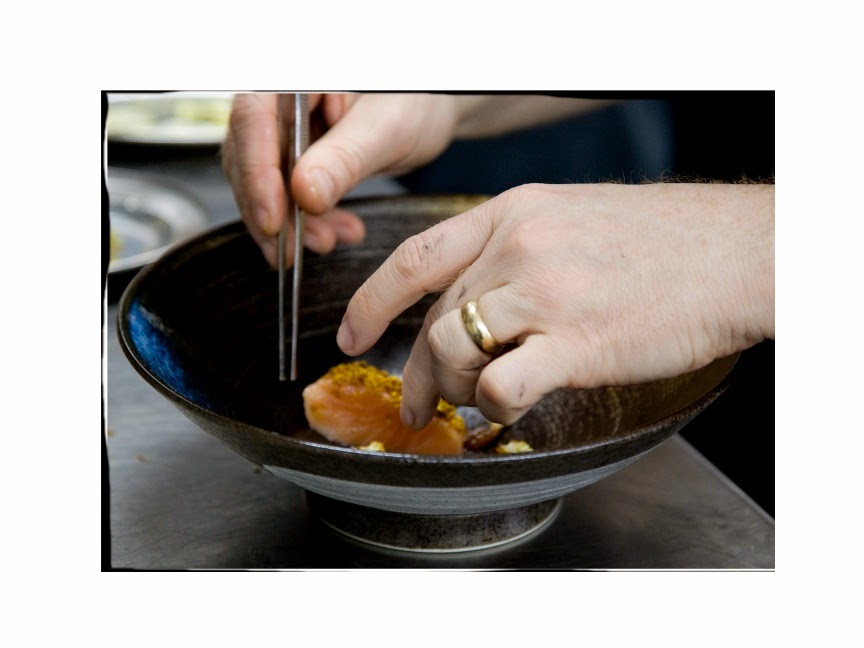 |
| Precision |
 |
| The are instructed in construction of a new dish by Kenny Atkinson |
 |
| The delicate work |
 |
| Taste test |
 |
| The Result |


I owe a huge debt of gratitude for the cooperation and opportunity to work alongside an a amazing team of creative talent. The House of Tides is truly the home of Gastronomic excellence in the North East of England.
Ian Meeson Photography
Bibliography:
http://www.alternativephotography.com
http://www.bbc.co.uk/history/historic_figures/fox_talbot_william_henry.shtml [Accessed February 12th 2014]
http://www.thebppa.com [Accessed February 10-2014]
http://www.david-campbell.org/2010/11/18/photography-and-narrative [Accessed February 28th 2014]
Education Psychology can be viewed at http://psychology.about.com/od/aindex/g/what-is-altruism.htm [Accessed February 12-2014]
http://www.fotoart.gr/photography/history/pioneers [Accessed February 12-2014]
http://www.leegallery.com [Accessed February 12-2014]
http://www.martinparr.com [Accessed February 12-2014]
Book
Kee Robert (1989). Picture Post Album 50th anniversary collection. London: Barrie & Jenkins Ltd. 160.
Photo journalism ‘The Professional Approach’ 6th edition


